
How to Discover Your Leadership Calling Through Spiritual Formation Practices—Not Peak Moments
The Practical Guide to Purpose Discovery in Desolation, Where Real Transformation Happens
Consolation and Desolation
I first wrote this post back in November and have been reflecting on it during Lent. I'm drawing on Kyle Strobel and John Coe's When God Seems Distant, which describes two spiritual seasons: ‘consolation’ (moments of divine pleasure and excitement) and ‘desolation’ (seasons of dryness where truth about ourselves emerges). Both are gifts. Most of us chase consolation and resist desolation—but desolation is where real transformation happens.
Below, I use the words “extraordinary” and “ordinary.” In the Christian tradition, the words “consolation” and “desolation” were used. Consolation is the pleasure and excitement of the Lord as he lifts us from experiencing the brokenness and sinfulness of our souls.
Strobel and Coe write, “the consolation of the Lord releases us to be driven by the Spirit.” Later, they write, “We hear a sermon, and even if it is a really hard word to hear, naming the very things we struggle with, there is a deep and abiding ‘Yes!’ in our souls. This allows us to freely embrace the call of obedience.”
Friends, we all know that consolation fades. In its place, the Lord offers us the gift of desolation. Desolation is the place where the Lord allows for pleasure and excitement to wane. “What is hidden in the recesses emerges. The truth of our character, and the pains and sinfulness we have internalized, come forth as we are being called into a deeper kind of formation.”
I don’t like desolation. I enjoy the Lord's pleasure and excitement. I am learning to embrace the seasons of desolation as opportunities to refine my character and deepen my awareness of God’s purpose for my life.
The Dangerous Myth of Dramatic Calling
We're addicted to the extraordinary and to pleasure, restlessly pursuing grand adventures and emotional highs to reveal our purpose. This addiction has infected how we think about calling—we wait for the retreat, conference, or crisis that finally provides clarity. But decisions made during emotional spikes consistently fail to account for long-term consequences.
Effective leaders develop protocols that function under pressure rather than relying solely on emotional moments. While mountaintop experiences matter, discovering calling requires sustained attention, patient listening, and a willingness to find meaning in the mundane.
The Prophets of Baal
King Ahab and Queen Jezebel of the Northern Kingdom of Israel had long refused to follow the God of the Jews. As a way of challenging this failure of belief, Elijah declared that there would be no dew or rain for a period of years until he gave the word. King Ahab summoned Elijah into his presence and called him a troublemaker. Elijah retorted that Ahad and Jezebel were the troublemakers because they had refused to obey the Lord's commands and instead had chosen to worship images of Baal.
Elijah asked for a confrontation between the 450 prophets of Baal and himself, representing God. The confrontation was to take place on Mount Carmel. He issued a challenge:
Now bring two bulls. The prophets of Baal may choose whichever they wish and cut it into pieces and lay it on the wood of their altar, but without setting fire to it. I will prepare the other bull and lay it on the altar, but not set fire to it. Then call on the name of your god and I will call on the name of the LORD. The god who answers by setting fire to the wood is the true God!
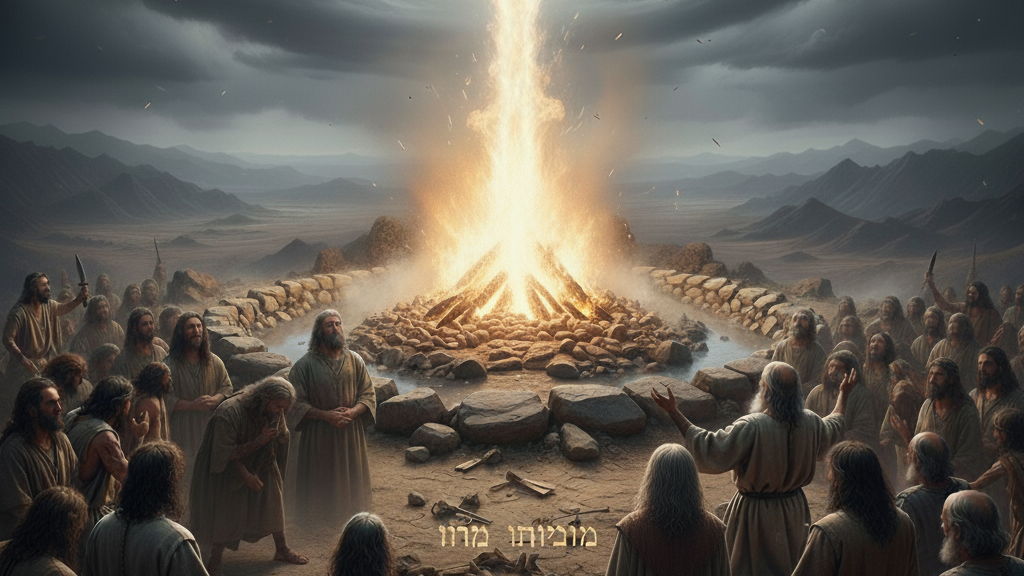
The prophets of Baal danced and cut themselves from morning until evening, calling on their god to send fire. Nothing happened. Then Elijah prayed once, and fire flashed down from heaven, consuming not just the sacrifice but the wood, stones, dust, and even the water in the trench. The people fell face down: “The Lord—he is God!” (The entire story is told in 1 Kings 17-19).
It was the ultimate leadership moment. Dramatic. Undeniable. Full of the pleasure and excitement of consolation via a dramatic move of God. The kind of story that gets retold for millennia.
When Ahab arrived home after the Lord’s great victory, he told Jezebel about Elijah’s great victory over the prophets of Baal. Immediately, Jezebel sent a message promising to kill Elijah by the next day.
Fresh from the consolation of his experience of the Lord’s great victory over the Baal prophets, Elijah stood strong and trusted God in the face of Jezebel’s threat, correct? Wrong, instead, Elijah was afraid for his life and fled into the wilderness. He sat down under a desert shrub and declared, “I’d done.” He asked God to take his life.
Immediately after an experience of consolation, Elijah fell into the pit of despair. In the face of his victory, Elijah struggled to see the goodness of God amid the continual failure of his people.
Ultimately, Elijah needed direction for his own life; God didn't speak through windstorms, earthquakes, or fire (consolation). God spoke in a whisper so gentle (desolation) that Elijah almost missed it (see 1 Kings 19).
Here's what I've learned after two decades of seeing leadership in action, serving as a Navy chaplain, and mentoring leaders across sectors: I've discovered that authentic spiritual leadership isn't found in dramatic moments but in the daily disciplines of staying present in desolation.
If you're leaning on the good times to guide you, or waiting for a dramatic revelation to discover your purpose, you'll be waiting a long time. The leaders who find their most profound sense of purpose aren't the ones chasing mountaintop experiences of consolation. They’re the ones who've learned to pay attention in the valley of desolation.
The Heat That Reveals Who You Really Are
A crucible is the container where heat and pressure transform raw materials—gold must be heated to 1,948°F to separate impurities.
Rich, an executive director, faced a bitter conflict between junior leaders. Rather than firing them or escaping to a ‘better opportunity,’ Rich stayed present.
Six months of difficult one-on-ones and careful listening resolved the conflict. What seemed like his worst season became the foundation for his mediation consultancy. Rich discovered his calling not through a mountaintop moment, but through sustained, daily presence in the hard work.
The Three Stages of Transformation
Drawing on ancient Christian spiritual formation traditions and contemporary research, I’ve identified three stages leaders typically move through as they discover their calling through ordinary faithfulness. Understanding these stages helps you recognize where you are and what's required to move forward.
Stage 1: Confrontation—Breaking Through the False Self
An essential first step in discovering leadership purpose is breaking through our ego, often through a severe test. This stage involves moving from self-reliance to reliance on something beyond ourselves.
In this desolation stage, there's a fierce stripping away of the false self—the identity we've constructed based on circumstances, other people’s opinions, and cultural expectations.
I worked with a domineering leader who received brutally honest feedback. He chose to embrace rather than resist the confrontation—stripping away his false self (the leader who needed to dominate) and revealing his authentic self. Confrontation isn't punishment; it's an invitation to become who you're meant to be.
Stage 2: Self-Soothing—Developing Internal Resources
Leaders in the self-soothing stage learn to tolerate discomfort, regulate emotions, and draw on internal resources rather than external relief. They detach from the need for constant validation, from the need to be right, and from controlling outcomes.
This uncomfortable stage requires staying present with anxiety rather than retreating to safe familiarity—it's where leadership becomes sustainable rather than merely survivable.
Stage 3: Trust—Leading from Your True Self
Trust represents an intimate union—a maturing ability to self-reflect and self-soothe, combined with a growing capacity to live in a connected relationship with God and others. Leaders at this stage embody genuine spiritual leadership according to who God made them to be, without masks, in alignment with their core values, passions, and long-term goals.
When we lead from this place of trust, we spend most of our time operating from our strengths, abilities, and passions. We’ve proactively addressed our weaknesses through God's grace and strength. We lead with a profound sense of harmony that spreads into the lives of those impacted by our leadership.
Interested in going deeper in your spiritual formation?
I have openings for a few more people interested in joining me in spiritual direction. Find out more about spiritual direction and schedule a call at gregwoodard.com/services or complete the form below and click the button to schedule a discernment call.
Why the Ordinary Matters More Than the Extraordinary
Success results from living the ordinary extraordinarily well. We celebrate the dramatic and dismiss the mundane, yet genuine transformation happens in the ordinary cauldron, away from the spotlight.
Desolation experiences create urgency naturally. There’s no place for complacency in the heat of a hard time. The same is true in discovering our calling. The ordinary pressures of sustained leadership—the difficult conversations, the persistent conflicts, the daily decisions that compound over time—create the conditions for genuine transformation.
Practical Disciplines for Discovering Calling in the Ordinary
How do we actually discover our leadership calling through the ordinary rather than waiting for the extraordinary? Here are disciplines that create space for gradual discovery:
Stay Present in Your Crucible
When you're in a season of desolation, resist the urge to escape or make dramatic changes. Instead, ask: “What is this season trying to teach me? What capacities am I developing that I didn't know I had? How is this difficulty revealing my true priorities?”
The crucible isn't something to escape—it's where your calling gets forged. Leaders who learn to stay present in difficult situations develop the capacity for stress management and decision-making that serves them for decades.
Seek Honest Feedback Consistently
Don't wait for annual reviews or crisis moments. Create a personal board of advisors—people who know you well and have permission to speak truth into your life. Ask them regularly: “Where do you see me come alive? Where do you see me struggling? What patterns do you notice in how I lead?”
Confrontations that lead to growth rarely come from mountaintop moments. They come from trusted people who care enough to tell you the truth in ordinary conversations.
Establish Regular Reflection Practices
Set aside time weekly—not just when you're in crisis—to reflect on where you experienced energy, where you felt aligned with your values, and where you sensed you were making a meaningful contribution. Keep a journal tracking these patterns over months and years.
Purpose reveals itself through patterns, not single events. The discipline of regular reflection trains you to notice the whispers that the noise of daily life would otherwise drown out.
Embrace the Long Obedience
Eugene Peterson wrote about “a long obedience in the same direction”—the patient, sustained faithfulness that characterizes genuine spiritual formation. Discovering your leadership calling requires the same commitment. Finding your vocation takes time and consistent practice in the ordinary, not a single extraordinary mountaintop moment. It characterizes genuine spiritual formation.
The Whisper You're Missing
Your calling isn’t hiding on a distant mountaintop. It’s being revealed right now, in the ordinary moments of your everyday leadership—if you have the patience and presence to listen.
Discovering your leadership purpose requires disciplined spiritual exercises that prepare you for the long journey ahead. It requires the courage to stay present in crucible seasons rather than seeking escape. It requires the humility to recognize that your worst professional season might become the foundation for your most meaningful contribution.
When Elijah needed personal guidance about his calling and direction, God didn’t speak through windstorms, earthquakes, or fire. God spoke in a whisper.
What ordinary crucible are you in right now that might be forging your calling? What would change if you stopped waiting for the mountaintop and started paying attention to the whisper in the valley?
The fire from heaven makes a great story. But the whisper changes your life. Consolation is a gift, so is desolation.
I have openings for few more people who want to join me in spiritual direction.
Check out gregwoodard.com/services for more information and to schedule a time for your discernment call.
